Workplace Wellbeing Academy
Our Story

A Chartered Engineer. A Breakdown. A New Purpose.
Glen Ridgway was a Chartered Civil Engineer heading up a team of flood management engineers. He worked long hours, sacrificed weekends, and accepted stress as a normal part of the job. Then came his first breakdown.
That experience didn’t just interrupt his career — it knocked him off the path he thought he’d mapped out for himself. But it also planted the seed for everything that followed.
When Glen returned to work, he started telling his story at staff meetings and lunch-and-learn sessions.
“This is me. This is my story. Trust me, you really don’t want to be like me.”
He quickly discovered he was never the only person in the room who had experienced the distress of mental illness — either directly or through a family member or friend.
At that time, mental health was rarely discussed in the workplace. Mostly it was ignored, dismissed, or simply misunderstood. So simply talking about it seemed like a huge step forward. From those first conversations, a global network of over 1,200 positive mental health champions grew across 200 offices on six continents — reaching tens of thousands of people, changing attitudes, and saving lives.
Read more
But the longer Glen worked in this space, the clearer it became that mental health — as important as it is — was only part of the picture. Wellbeing is not simply the absence of illness. It is about thriving: physically, mentally, emotionally, socially and spiritually. These dimensions are deeply interconnected, and addressing just one while ignoring the others will always fall short. That realisation changed everything.
The Founding of the Academy
The Workplace Wellbeing Academy was born out of a shared conviction that organisations could — and should — do far more for the people who give their working lives to them. Glen founded the Academy with Bill Cunningham and Iain Smith, whose shared vision, enthusiasm and focus were essential in bringing both the Academy and The Wellbeing Advantage to life.
What makes the Academy genuinely distinctive is the breadth and depth of lived experience and expertise that the whole team brings to every piece of work. Between them, the people of the Workplace Wellbeing Academy have spent careers in psychology, mental health education, leadership development, communications, neurodivergence, burnout and resilience, health promotion, and organisational change — across the NHS, armed forces, major infrastructure programmes, local government, education and beyond.
Enriched at every turn by colleagues who questioned, stretched and sharpened our ideas, the Academy’s thinking goes far deeper than any one person’s story could take it.
Why Wellbeing Matters
Beyond being free from illness
Wellbeing means thriving — physically, mentally, emotionally, socially and spiritually. All these dimensions are interconnected, and all need conscious effort to cultivate.
Felt, Not Performed
The strongest workplaces never just speak of trust and respect — they live it. Positive wellbeing means an environment where everyone genuinely feels appreciated, heard and cared for.
Built Over Time
Organisations have moved from simply catching people when they fall, to genuinely putting people at the centre of how they work. Culture is like a personality — shaped by shared values, beliefs and habits built over time.
Shared by Everyone
Real transformation only happens when all voices are heard. Employees are the best source of ideas and feedback — involving people at every stage is what makes change stick.
Infectious by Nature
When people love coming to work, feel valued and leave energised instead of exhausted, that positive energy ripples outward — into families, friends and communities beyond the workplace.
A New Model for Workplace Wellbeing
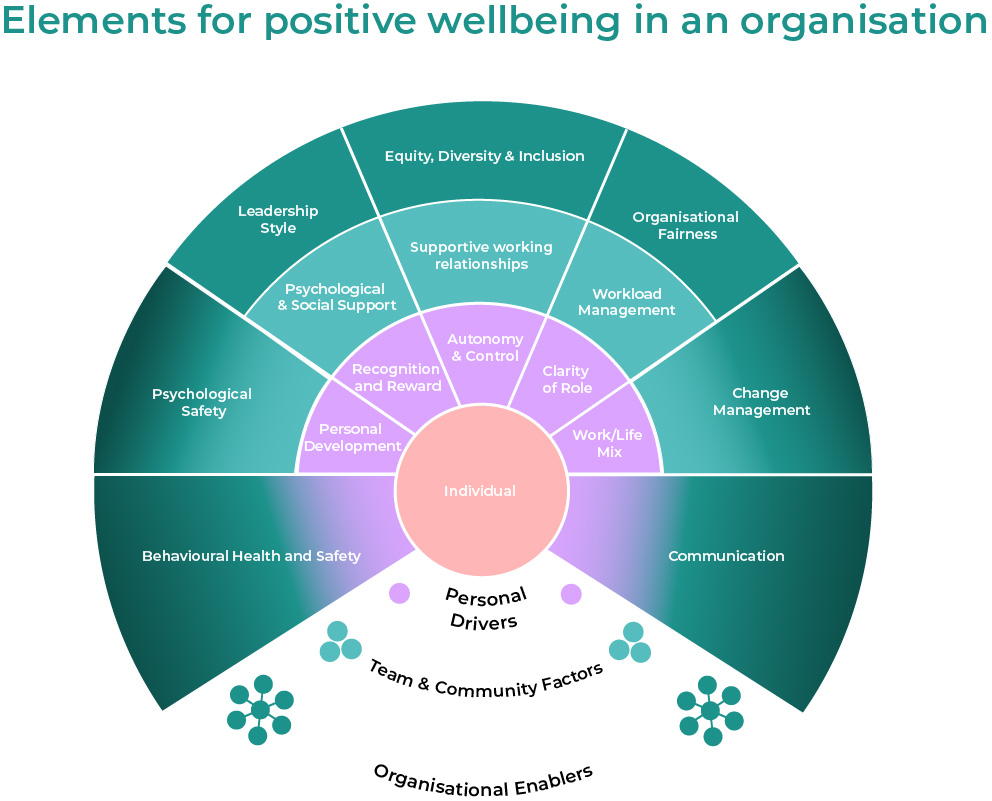
15 Elements. Three Domains. One Connected Approach.
Wellbeing goes beyond being “free from illness.” It’s about thriving physically, mentally, emotionally, socially and spiritually. All these things are interconnected and they need conscious effort to build environments — at work and at home — which support personal fulfilment and resilience.
Just as a great performance depends on every section of the orchestra playing its part — and on the interplay between them — genuine workplace wellbeing depends on multiple dimensions working in harmony. No single instrument carries the whole piece; no single initiative transforms a culture.
Our ’Orchestra Pit’ model identifies 15 elements spanning three domains: Personal Drivers (individual motivation, growth and purpose), Team & Community (relationships, support, workload and collaboration), and Organisational Enablers (the leadership, values and systems that either unlock or block positive change).
Personal Drivers
Individual motivation, growth and purpose — the foundations of each person’s relationship with work and wellbeing.
Team & Community
Relationships, support, workload and collaboration — the connections that make work feel meaningful and safe.
Organisational Enablers
Leadership, values and systems that either unlock or block positive change — the structural conditions for wellbeing to take root.
The guiding principle behind every element is simple: if these areas are handled well, they boost wellbeing for everyone; if they are mishandled, they become risks. Many organisations are already doing great work in some of these areas. This model is designed to build on what you already have.
The model is explored in depth in The Wellbeing Advantage — each element given its own chapter, each chapter designed so you can read it independently or as part of the whole.
Workplace Wellbeing Academy
Contact Us
Get in touch today to join the growing community committed to workplace wellbeing.